
Opinion/Commentary · Election-week series, October 28, 2026
A month ago, “if Democrats take the House” was a campaign hypothetical. Now it’s the market base case. Prediction markets put a Democratic House win at roughly 92 percent, while forecast models are less bullish at 79–85 percent; the generic ballot sits at about D+8 to D+9, and Cook projects Democratic gains of 9 to 19 seats.
Democrats currently hold 214 seated House seats against 218 Republicans, with one independent who caucuses with Republicans and two vacancies — so the flip requires a net gain of four.
On the numbers, that is the likely outcome, not the long shot. Which asks the interesting question no longer whether Democrats could win, but what a Democratic majority would do with power — and whether its plan survives contact with the institutions it still would not control.
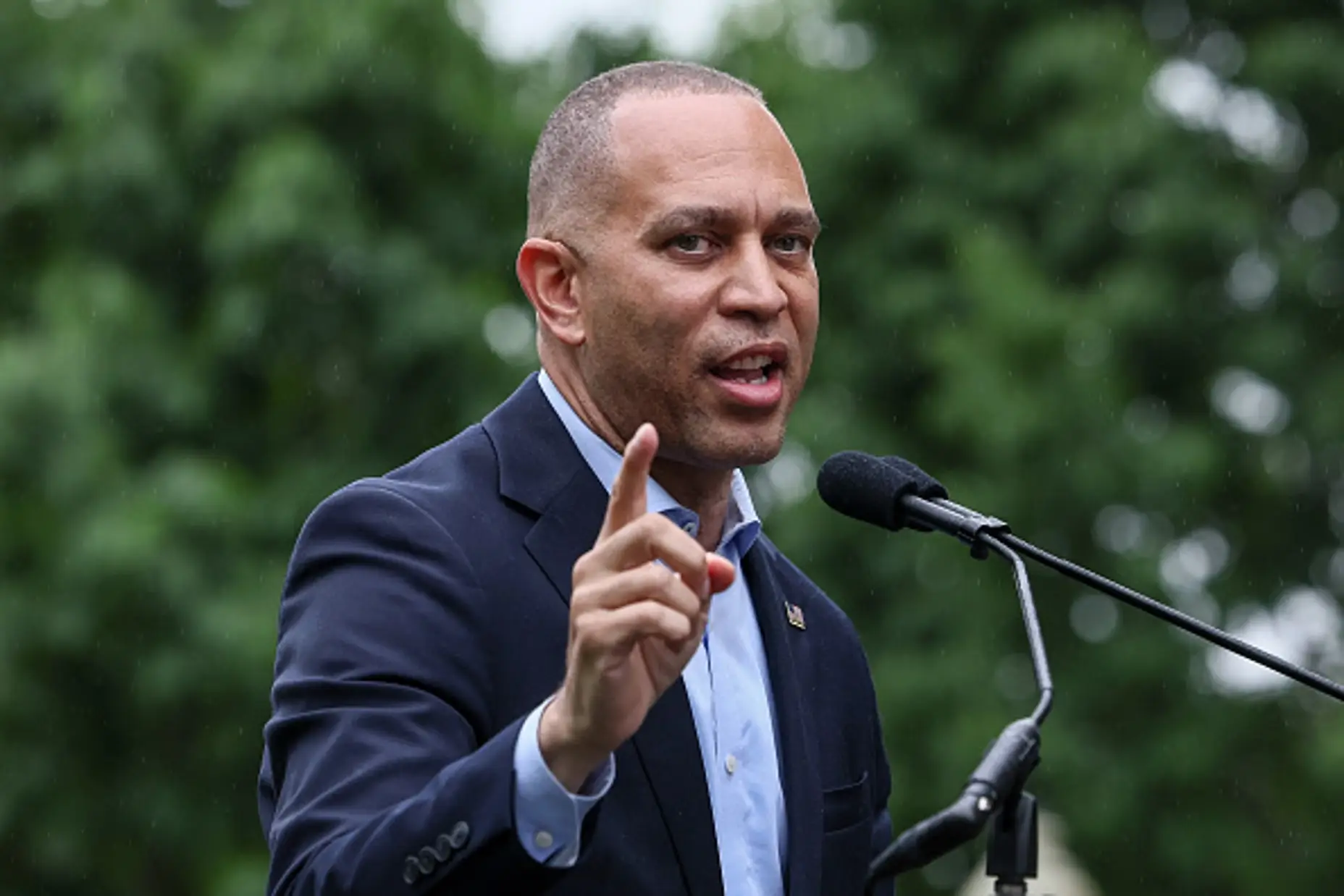
House Democrats, unusually for an opposition party, have told voters in advance. According to Associated Press reporting on October 13, Minority Leader Hakeem Jeffries says the party will be united “right out of the gate” on an agenda it expects to launch in the first 100 hours after the new Congress is seated in January.
The legislative half is affordability: reinstate the Affordable Care Act tax credits that expired in 2025, reverse the Medicaid cuts in the One Big Beautiful Bill Act, undo the tariff regime, and hold votes against the Iran war, including war-powers resolutions.
“Fighting for an affordable America — that’s what unites Democrats all across the country,” Jeffries said. “The cost of living is way too high and far too many people who are working hard, playing by the rules, can’t thrive and can barely survive — and are drowning — in the Trump economy.
The other half runs in parallel: investigations. Ranking Democrats on the Oversight and Judiciary committees have been tasked with preparing inquiries into the president, his family, and his administration, as part of an anti-corruption agenda.
Jeffries has said impeachment is “neither on nor off the table,” and that oversight will “follow the facts” and be guided by the Constitution. He has also accused the Trump Justice Department of weaponizing criminal investigations against political opponents — a charge to attribute to him, not to adopt as fact.
Behind the agenda sits an organizational tell: five working groups — health care, housing, groceries and goods, gas and utilities, caregiving — each headed by one progressive and one centrist Democrat. Health care, for instance, is run jointly by Rep. Alexandria Ocasio-Cortez and Rep. Terri Sewell. The leadership bets that a plan every House Democrat can support can survive a narrow majority.
The test: what a House alone can do
Here is where the plan meets its constraint, and it is the test this piece applies — the same test the companion piece applies to the Republican closing argument
A House majority, on its own, can do much of the second half and very little of the first. It can investigate, subpoena, and hold hearings. It can pass messaging bills. It can force war-powers votes that put every member on the record. Without the Senate and a presidential signature, it cannot reinstate a tax credit, reverse Medicaid cut or repeal a tariff.
Every item on the legislative half of the 100-day list dies in one of those two places unless the Senate also flips — and even the most optimistic market readings give Democrats only about a two-in-three chance there, with models closer to a coin flip.
So, the honest scorecard for a Democratic House looks like this: the oversight agenda is deliverable on day one; the affordability agenda, the part voters ranked first, is largely promissory until and unless the other chamber cooperates. That is not an argument against the plan. It is the difference between a governing program and a campaign platform, and voters deserve to hear it plainly before the election, not discover it in February.
The tension inside the majority
The second test is internal. AP-NORC polling has found roughly half of Democratic voters want “complete upheaval” rather than incremental change. The working-group structure — a progressive and a centrist at every table — is leadership’s answer to that tension. But co-chairs are not consensus.
The 100-day list, as announced, leans heavily toward the affordability center: groceries, gas, housing, health care. The upheaval wing gets the investigations.
Whether that division of labor holds depends on whether the investigations produce documented findings or merely airtime—and whether the affordability agenda keeps moving while the cameras are pointed elsewhere.
There is a comparator, and Democrats should not be spared it: the last House majority’s investigation program. Judge this one by the same standard — findings versus footage, and whether the party’s stated priority is still advancing six months in. A majority that spends its first 100 days litigating the last administration while its own legislative promises stall will have answered the “what” question in the worst possible way.
The bottom line
None of this makes a Democratic House illegitimate or unimportant. A majority that investigates, passes affordability bills even knowing the Senate may block them, and forces recorded votes on war powers is exercising real constitutional power.
But the gap between the plan as announced and the plan as deliverable is the story of the next Congress if Democrats win — and their own announcement, to its credit, makes that gap measurable.
The companion piece applies the identical test to the other side: the Republicans’ closing argument, stress-tested by the same standard. A publication that scrutinizes one party’s promises and waves through the other’s is not doing accountability. It is simply doing PR.
Nicholas A. Owoyemi
Moderate Voices of America (MVA)
30 Wall Street, 8th Floor
New York, New York 10005
212 608-1999
www.moderatevoices.org