
Election-week series November 1, 2026
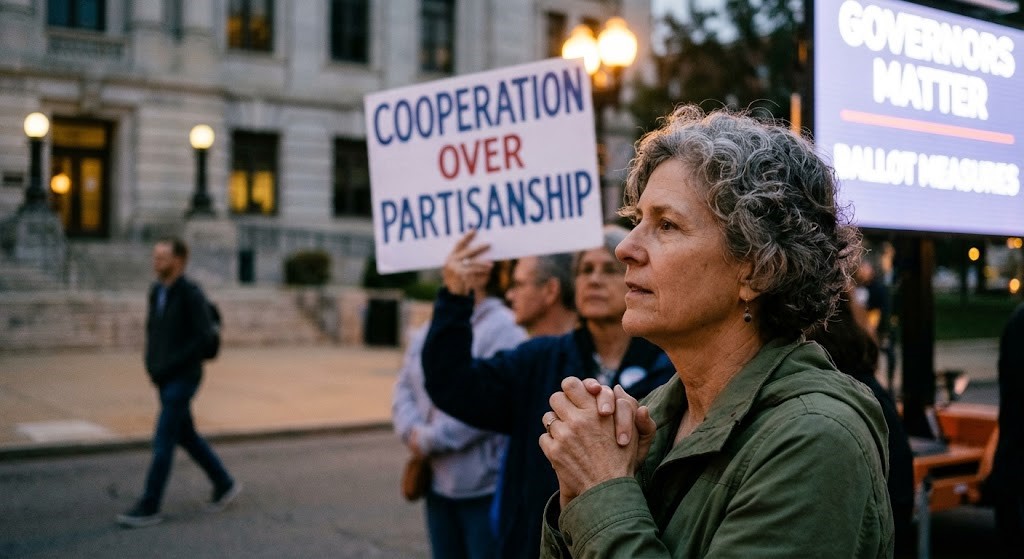
Most voters walking into a booth on Tuesday will face a ballot much longer than the two federal races dominating the coverage. Thirty-six governorships are at stake, and 145 statewide ballot measures across 39 states.
The Senate and House results will lead Wednesday’s news. But the governors elected Tuesday will sign the maps, budgets, and election laws for the next decade, and the ballot measures will settle questions Congress has spent years leaving unresolved. This piece is about that longer ballot.
Governors: 36 races, four toss-ups
The Cook Political Report’s final October 27 ratings for the 36 governor races: Solid Democratic 13, Lean Democratic 6, Toss-Up 4, Lean Republican 3, Likely Republican 3, Solid Republican 7.
The four toss-ups are Wisconsin, Georgia, Nevada, and Kansas — and the list itself carries a warning about stale maps. Ohio appeared as a toss-up in earlier snapshots but moved to Lean Democratic on October 23. Kansas moved from Lean Republican to Toss-Up on October 27, and Nebraska moved from Likely Republican to Lean Republican the same day. Anyone reading this map from a September snapshot would get all three wrong.
The competitive races, in brief:
Wisconsin (open seat, toss-up). Democrat David Crowley vs. Republican Tom Tiffany. The final Marquette poll (fielded October 14–22) had Crowley ahead 51–44 among likely voters and 47–44 among registered voters — a lead, not a lock.
Georgia (open seat, toss-up). Republican Rick Jackson vs. Democrat Keisha Lance Bottoms. On polling averages, this is the closest thing to a pure coin flip on the map, with Jackson about a point ahead.
Nevada (Republican incumbent, toss-up). Governor Joe Lombardo vs. Attorney General Aaron Ford. Cook and Sabato rate it a toss-up; Inside Elections rates it Tilt Republican. Polling is thin and split — the RealClearPolitics average was tied 42–42 — so any single poll here, particularly a partisan-sponsored one, deserves skepticism.
Kansas (Republican incumbent, toss-up). Senator Roger Marshall vs. Democrat Adam Hamilton, in a state that has not elected a Democrat to the Senate in roughly 94 years—a sign that a toss-up rating is about this race, not history.
And the race to watch just outside the toss-up column: Ohio (Lean Democratic). Democrat Amy Acton vs. Republican Vivek Ramaswamy.
Cook’s Lean Democratic rating sounds comfortable; the polling average, about +2 for Acton, is not. Suffolk University / USA TODAY (October 21–26) had Acton 48–44, inside its ±4.4-point margin and therefore statistically too close to call, while Marist (October 15–18) had Acton 51–43. “Lean” means a slight edge. It does not mean settled.
Why do governors matter beyond their states? They sign state budgets, sign or veto redistricting maps, and election-administration laws, and they form the bench for 2028. A party that loses the Senate but wins the governorships has still won a great deal of governing power.
Ballot measures: 145 decisions, and election rules lead them
Voters will decide 145 statewide measures in 39 states. Thirty-nine of them are election-related — a record — with 34 of those on election policy specifically. The election-policy cluster is best read measure by measure, because a “yes” means something different in each state, and the coalitions on each side differ too. This piece takes no position on any measure; it explains what each side would do.
- Voter ID and citizenship verification: California Proposition 39 (voter ID / citizenship verification), Nevada Question 7 (voter ID), and Alaska Measure 3 (citizenship-only voting). Six states in total have citizenship-only voting measures, per Ballotpedia’s October 20 summary: Alaska, Arizona, Arkansas, Kansas, South Dakota, and West Virginia.
- Redistricting: Colorado Amendment 86 (a commission plus supreme-court approval for mid-decade redistricting), Maryland Question 3 (congressional redistricting criteria), and Missouri Proposition A (a referendum on the state’s congressional map).
- Primaries and ranked choice: Alaska Measure 2 would repeal top-four ranked-choice voting; Massachusetts Question 3 would move to top-two primaries. Beyond election policy, the ballot holds the year’s other arguments in miniature. Taxes and spending, including California Proposition 40, which would create the nation’s first state wealth tax. Abortion measures are moving in both directions: Idaho Proposition 1, Nevada Question 6, and Virginia Question 1 would establish or maintain a right to abortion, while Missouri Amendment 3 would repeal the reproductive-freedom amendment voters approved in 2024. And housing measures — six in four states, the most in a single year since 2006.
A voter-ID measure in Nevada and a voter-ID measure in California are not the same proposal, and treating them as one national referendum would mislead readers in both states. The same applies across the ballot: the measure is the unit of analysis, not the theme.
The cooperation ledger, with the receipts
This series has spent the week scrutinizing both parties’ claims about governing. The record of this Congress corrects the idea that bipartisanship never happens — but only if the receipts are real. They are, and they were checked against the House and Senate records for this piece:
- Housing for the 21st Century Act (H.R. 6644): House 390–9 (February 9), Senate 89–10 (March 12). It became law in July.
- The three-bill minibus (H.R. 6938) — Commerce, Justice, Science; Energy and Water; Interior and Environment: House 397–28 (January 8; 191 Republicans and 206 Democrats in favor), Senate 82–15 (January 15).
- The FY26 consolidated appropriations package (H.R. 7148): Senate 71–29 (January 30); it became Public Law 119-75 in February.
- The Retire through Ownership Act (S. 2403): Senate by unanimous consent (October 2025), House 401–14 (September 16, 2026), signed October 15.
- The ACT for ALS Reauthorization (H.R. 8205): House by voice vote (July 22), Senate by voice vote (September 28), after a 46–0 committee vote; it extends the ALS programs through fiscal year 2031.
The pattern in that list is the honest takeaway, and it cuts both ways. Cooperation is easiest to find where the issue is local, technical, or one both parties’ voters agree on — housing supply, science funding, retirement savings, rare-disease research. It is hardest where the issue defines the parties.
The contrast case is the One Big Beautiful Bill Act: House 215–214 on first passage and 218–214 on final concurrence, Senate 51–50, with not a single Democratic vote in either chamber. A Congress that can pass housing 390–9 and a tax-and-spending bill with zero opposition votes is not uniformly cooperative nor uniformly partisan. It is selective — and that selectivity is itself the story.
The bottom line
Tuesday night’s coverage will be about Washington: who controls the Senate, who controls the House. Wednesday’s coverage should be wider.
The governors elected Tuesday will decide what the maps, budgets, and election laws of the next decade look like.
The ballot measures will decide voter ID, redistricting, primaries, taxes, and abortion policy in state after state — questions Congress has debated and not resolved.
A reader who follows only the federal races will know who won power in Washington and miss much of what that power will actually do. The state ballot is where the election’s consequences start.
The Editorial Board
Moderate Voices of America (MVA)
30 Wall Street, 8th Floor
New York, New York 10005
212 608-1999
www.moderatevoices.org